A Whirling Dervish takes it for a spin
Not exactly sure how the idea of Vietnam became a destination, but it did. And what followed was a beautiful, often exotic run of new sights, sounds, flavors, and, unexpectedly, friendships.
I had never been on a tour before, so deciding how long, where, and who to go with wasn’t simple. In the end, I chose Intrepid Travel through TourHub—mostly because the itinerary had three things I liked: a boat, a train, and a plane. That felt like enough.
And so, the 10-day journey began in Hanoi on a Friday night, in a hotel lobby filled with strangers who would, eventually, not be strangers.
There were eleven of us, plus our guide, Jay—real name Nhan — from the Mekong Delta. He’d been doing this for nine years and had that calm confidence of someone who knew not just where we were going, but how it would unfold.
Dinner that first night was at a local Vietnamese restaurant, one long table. Conversation didn’t exactly flow—too much distance, too many unknowns—but you could feel it starting.
Hanoi
The next morning, we left at 8 a.m. for Hạ Long Bay. The drive was long and, for the most part, forgettable, broken up by a couple of stops. When we arrived, Jay mentioned something almost in passing: we’d have the boat to ourselves.
That’s when things began to shift.
There were two older men—one from Canada, one from Australia—both widowers who had found each other through travel. A tall, stylish woman from New York who turned out to be a serious shopper. A couple from California who worked at Trader Joe’s. A British woman whose accent alone could carry a conversation. Two Australians—one worked in a prison, the other looked uncannily like Walt Whitman. And Sree, from India, who seemed to have been everywhere.
A tour is a roll of the dice. Eleven people, ten days—eating, drinking, moving together. You wonder how it’s going to go. Whether it goes at all.
Too early to tell.
In Halong Bay, we explored caves, kayaked through limestone formations, and watched the place change as the light dropped. Night there is something else—quiet, almost cinematic.
From there, back to Hanoi, and then straight to the train station for an overnight ride south to Huế.
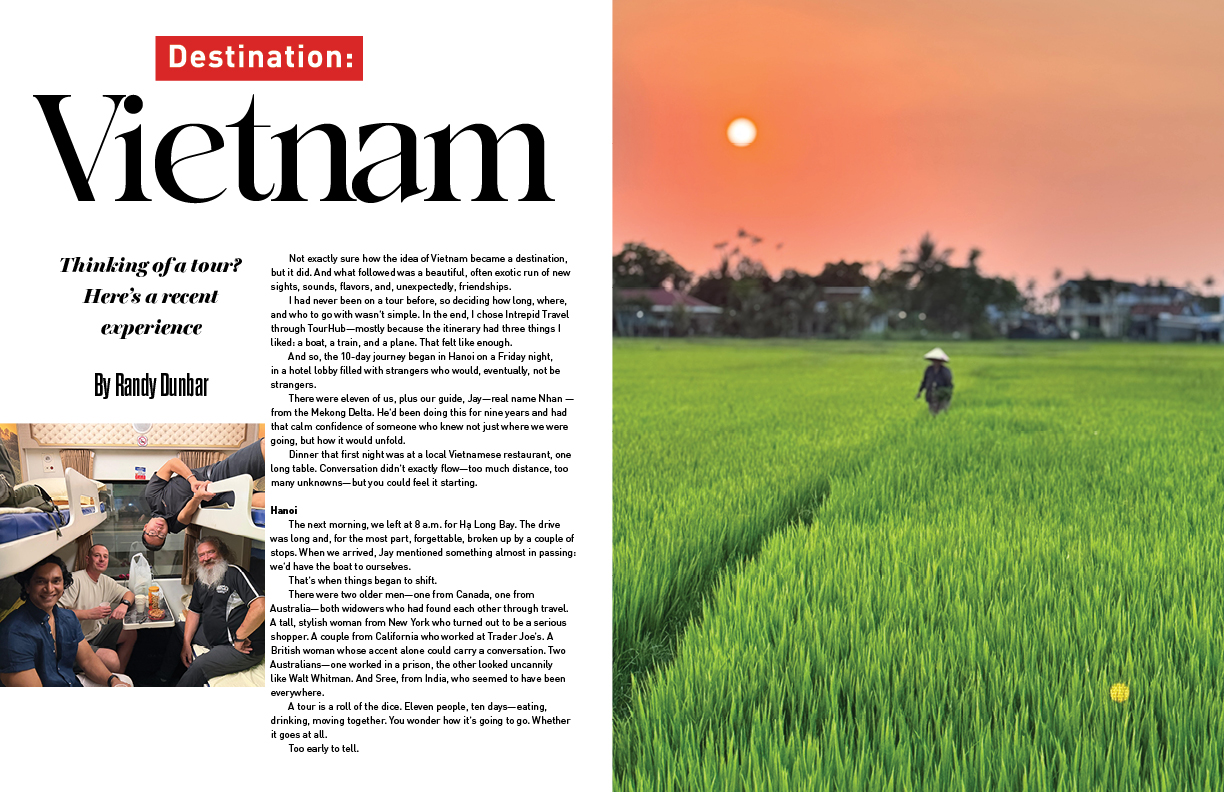
The cabins were tight—four people, two bunks—and we shared ours with Stan and Ernie, names we had only just picked up. The train itself was… not subtle. Loud, bumpy, impossible to ignore. But in that space, with nowhere to go, conversations opened up. Stories came out.
Sometime early in the morning, a woman with a cart came through offering strong Vietnamese coffee, and just like that, we were there.
Huế
Huế sits along the Perfume River, and for a long stretch—from 1802 to 1945—it was Vietnam’s imperial capital. You feel that history, even if you’re not looking for it. The Imperial City is still there, worn but standing, a reminder of what was.
The city itself moves slower. Quieter. There’s a weight to it, maybe from the war, maybe from everything before that.
We saw it from the back of motorbikes, which is equal parts thrilling and slightly insane. Traffic looks like chaos—no signals, no obvious rules—but somehow it works. People move through it like water.
Not once did we see an accident.
Hội An
Our next stop was Hội An. If Huế is reflective, Hội An leans the other way—cinematic, almost too perfect at times.
It’s a preserved trading port along the Thu Bồn River, dating back centuries. The buildings—yellow, weathered—feel like they’ve been held in place. It’s one of the few places in Vietnam that wasn’t heavily damaged during the war, and you can tell.
The Japanese Covered Bridge sits at the center, but the real draw is the shift from day to night.
During the day, it’s easy—cafés, tailor shops, bicycles everywhere. You wander, you stop, you lose track of time. I had always liked the look of a rounded-collar shirt—something out of an old English film—and here it was, made for me, for $30.
At night, the town changes. Lanterns come on, the river reflects everything, and small boats drift by carrying candles. It borders on staged, but you don’t really care.
We saw the Teh Dar Show—acrobatic, physical, no real dialogue, just movement telling the story. Afterward, the cast gathered outside, and for a moment the whole thing felt closer, less like a performance.
This was also where the group started to separate a bit. People did their own thing. It felt less like a tour, more like individual trips happening at the same time.
Ho Chi Minh City
By day seven, we flew south to Ho Chi Minh City—still Saigon, depending on who you ask.
It’s fast. That’s the first thing you notice. Everything moves—traffic, people, ideas. It feels modern, but not disconnected from what came before.
The war, which had been more of a background presence up to this point, feels closer here. The fall of Saigon isn’t abstract—it’s part of the city’s identity.
The War Remnants Museum makes that clear. It’s not easy to walk through. The tone is direct, emotional, and at times uncomfortable. You don’t leave unaffected.
Later that night, we ended up on Bùi Viện Street. Loud, crowded, neon everywhere. Locals, tourists, music spilling into the street. It feels closer to Phuket than anything else we’d seen. Not subtle, but memorable.
Mekong Delta
The next day, the Mekong Delta.
We arrived by boat, crossing brown, restless water before moving into narrower channels. The landscape closes in—green, dense, humid. Everything feels closer to the surface.
This area was heavily contested during the war, its maze of waterways making it nearly impossible to control. Now, it’s back to what it’s always been—agriculture, river life, routine.
We were given fruit—dragon fruit, rambutan, jackfruit—cut fresh, handed over without much explanation. It didn’t need one.
A small canoe took us through tighter canals, shaded and quiet. At one stop, we watched coconut milk being made—grated, pressed, simple. Nothing dressed up.
By late afternoon, we were back in Saigon for one last night.
The group, once a collection of strangers, now moved together easily. We went to Bến Thành Market, walked through, lingered longer than necessary.
No one was in a hurry.
Travel like this starts with uncertainty. You don’t know who the people will be, or how it will unfold. Somewhere along the way, that changes.
We made friends. Real ones.
We thanked Jay, who told us the next morning he’d head back to Hanoi and do it all again—with a new group, the same route, a different story.
Vietnam answers all of it.
Somewhere between the boat, the train, and the plane, you realize the destination was never really the point.
It was everything in between.